Health & wellness
Do Probiotics Need to Be Refrigerated?
If you've ever shopped for probiotics, you've probably noticed that some products are stored in the refrigerator while others sit on a regular shelf. It's natural to wonder whether refrigerated probiotics are more effective—or whether shelf-stable probiotics are somehow lower quality.
The answer is more nuanced. Whether a probiotic needs refrigeration depends on how it was formulated, manufactured, packaged, and tested for stability. Many modern probiotic supplements are specifically designed to remain stable at room temperature when stored according to the manufacturer's instructions. Others require refrigeration to help maintain the viability of the probiotic strains.
In this guide, you'll learn the difference between refrigerated and shelf-stable probiotics, whether you should refrigerate probiotics after opening, how heat affects probiotic supplements, and what to look for when choosing a high-quality product.
Key Takeaways
The storage advice depends on the product's tested stability and label instructions.
- Not all probiotics require refrigeration.
- Shelf-stable probiotics are formulated to remain stable at room temperature when stored correctly.
- Whether to refrigerate probiotics after opening depends on the manufacturer's storage instructions.
- Heat and humidity may reduce probiotic stability over time.
- Always follow the storage directions printed on the product label.
Table of Contents
Jump to the storage question most relevant to your probiotic.
- Why Some Probiotics Need Refrigeration—and Others Don't
- What Does "Shelf-Stable" Mean?
- Should You Refrigerate Probiotics After Opening?
- What Happens if Probiotics Get Too Hot?
- Does Refrigeration Make Probiotics Last Longer?
- How to Store Probiotics Properly
- Choosing a Shelf-Stable Probiotic
- Where This Fits in Balance ONE Formulas
- Bottom Line
- Frequently Asked Questions
Why Some Probiotics Need Refrigeration—and Others Don't
Probiotics are living microorganisms. To provide their intended benefits, they need to remain viable throughout manufacturing, shipping, storage, and until you consume them. Because living organisms are sensitive to environmental conditions, storage recommendations can differ from one product to another.
Years ago, refrigeration was much more common because many probiotic strains were less stable outside of cold storage. Advances in manufacturing, freeze-drying techniques, moisture control, protective packaging, and delivery technologies have since made it possible for many probiotic supplements to remain stable at room temperature.
For this reason, refrigeration alone is not a reliable indicator of product quality. A refrigerated probiotic is not automatically better than a shelf-stable one, and a shelf-stable probiotic is not automatically more advanced. What matters is whether the product has been formulated and tested to remain stable under its recommended storage conditions.
When evaluating a probiotic, it's often more helpful to consider factors such as manufacturing quality, stability testing, expiration dating, and whether the product has been designed to protect the probiotic organisms until they're consumed.
If you're new to probiotics, our guide to 16 Science-Based Health Benefits of Probiotics explains which probiotic benefits have been studied and why the strains used matter.
What Does "Shelf-Stable Probiotic" Mean?
A shelf-stable probiotic is formulated to maintain its quality and viability at normal room temperatures when stored according to the manufacturer's directions. That doesn't mean the probiotic can tolerate unlimited heat or poor storage conditions. Instead, it means the product has been designed for everyday storage outside the refrigerator.
Several factors influence whether a probiotic can be shelf stable, including:
- The specific probiotic strains used.
- Manufacturing and drying processes.
- Protection from moisture and oxygen.
- The packaging and bottle design.
- The delivery technology used by the manufacturer.
Many manufacturers also perform stability testing to verify that the product continues to meet its labelled specifications throughout its shelf life when stored as directed.
| Shelf-Stable Probiotics | Refrigerated Probiotics |
|---|---|
| Designed for room-temperature storage | Require refrigerated storage |
| Convenient for travel | May require cold storage during transport |
| Store according to label instructions | Store according to label instructions |
| Can remain stable without refrigeration when properly formulated | Depend on refrigeration to help maintain stability |
Rather than assuming one category is better than the other, look for products that clearly explain their storage recommendations and provide an expiration date that reflects expected stability.
Should You Refrigerate Probiotics After Opening?
One of the most common questions consumers ask is whether they should refrigerate probiotics after opening the bottle.
The answer depends entirely on the specific product.
If a probiotic is labelled as shelf stable, refrigeration after opening is usually unnecessary unless the manufacturer specifically recommends it. These products are generally designed to remain stable at room temperature throughout normal use.
On the other hand, probiotics that require refrigerated storage should typically remain refrigerated after opening to help preserve their quality.
In many cases, moisture can be just as important as temperature. Every time a bottle is opened, humid air can enter the container. Excess moisture may reduce stability over time, particularly if the bottle is frequently opened in humid environments.
To help protect your probiotic:
- Close the lid tightly after each use.
- Store the bottle in a cool, dry location.
- Avoid keeping it near sinks, dishwashers, or humid bathrooms.
- Keep the bottle away from direct sunlight.
The most important rule is simple: always follow the storage instructions provided on the product label.
What Happens if Probiotics Get Too Hot?
Heat is one of the environmental factors that can affect probiotic stability. While many shelf-stable probiotics are designed to tolerate normal room temperatures, prolonged exposure to excessive heat may reduce the number of viable microorganisms over time.
For example, leaving a probiotic bottle inside a hot car for several hours, storing it in direct sunlight, or exposing it to consistently high temperatures during storage may shorten its shelf life. The effect depends on factors such as the probiotic strains used, the formulation, packaging, and the duration of heat exposure.
Brief temperature fluctuations during shipping or everyday transport are not necessarily cause for concern. Many manufacturers design their products to withstand normal handling conditions. However, repeated or prolonged exposure to extreme heat is best avoided whenever possible.
If you're travelling, keep your probiotic in a cool, dry place rather than leaving it in a parked vehicle or on a sunny windowsill. Following the storage recommendations on the label remains the best way to maintain product quality.
Does Refrigeration Make Probiotics Last Longer?
It's reasonable to assume that refrigeration always extends the life of a probiotic supplement, but that's not necessarily the case.
For probiotics that are specifically formulated to be shelf stable, storing them in the refrigerator may not provide any meaningful advantage. Storage recommendations depend on the formulation and packaging. If the label states that room-temperature storage is appropriate, following those instructions is generally the best approach.
Conversely, if a probiotic requires refrigeration, consistently storing it at the recommended temperature can help maintain its quality throughout its shelf life.
Another important factor is the probiotic's expiration date. Some manufacturers list colony-forming units (CFUs) at the time of manufacture, while others guarantee the number of live microorganisms through the expiration date. Products that focus on viability at expiration may provide a clearer picture of what you're actually receiving.
How to Store Probiotics Properly
Whether your probiotic is refrigerated or shelf stable, good storage habits can help preserve its quality.
Best practices for storing probiotics
- Follow the storage instructions printed on the product label.
- Store the bottle in a cool, dry location.
- Keep the container tightly closed after each use.
- Avoid prolonged exposure to excessive heat.
- Protect the product from direct sunlight.
- Do not leave probiotics in a parked car for extended periods.
- Use the product before its expiration date.
Many people automatically store supplements in the bathroom medicine cabinet, but bathrooms often experience frequent changes in temperature and humidity. A bedroom drawer or kitchen cupboard away from heat sources is often a better choice for products intended for room-temperature storage.
If you travel frequently, shelf-stable probiotics can also be more convenient because they generally do not require refrigeration during routine travel, provided they're stored according to label instructions.
Choosing a Shelf-Stable Probiotic
If you're comparing probiotic supplements, storage recommendations are just one factor to consider. A quality product should clearly explain how it should be stored and what consumers can expect throughout its shelf life.
When evaluating probiotics, consider looking for:
- Clear storage instructions.
- An expiration date with documented stability.
- Protective packaging designed to reduce moisture exposure.
- A delivery system intended to help protect probiotic organisms until they reach the digestive tract.
- Third-party testing for purity and quality.
Remember that more refrigeration isn't necessarily better, just as higher CFU numbers don't automatically indicate a higher-quality product. Instead, evaluate the product as a whole, including its formulation, manufacturing standards, and storage guidance.
Where This Fits in Balance ONE Formulas
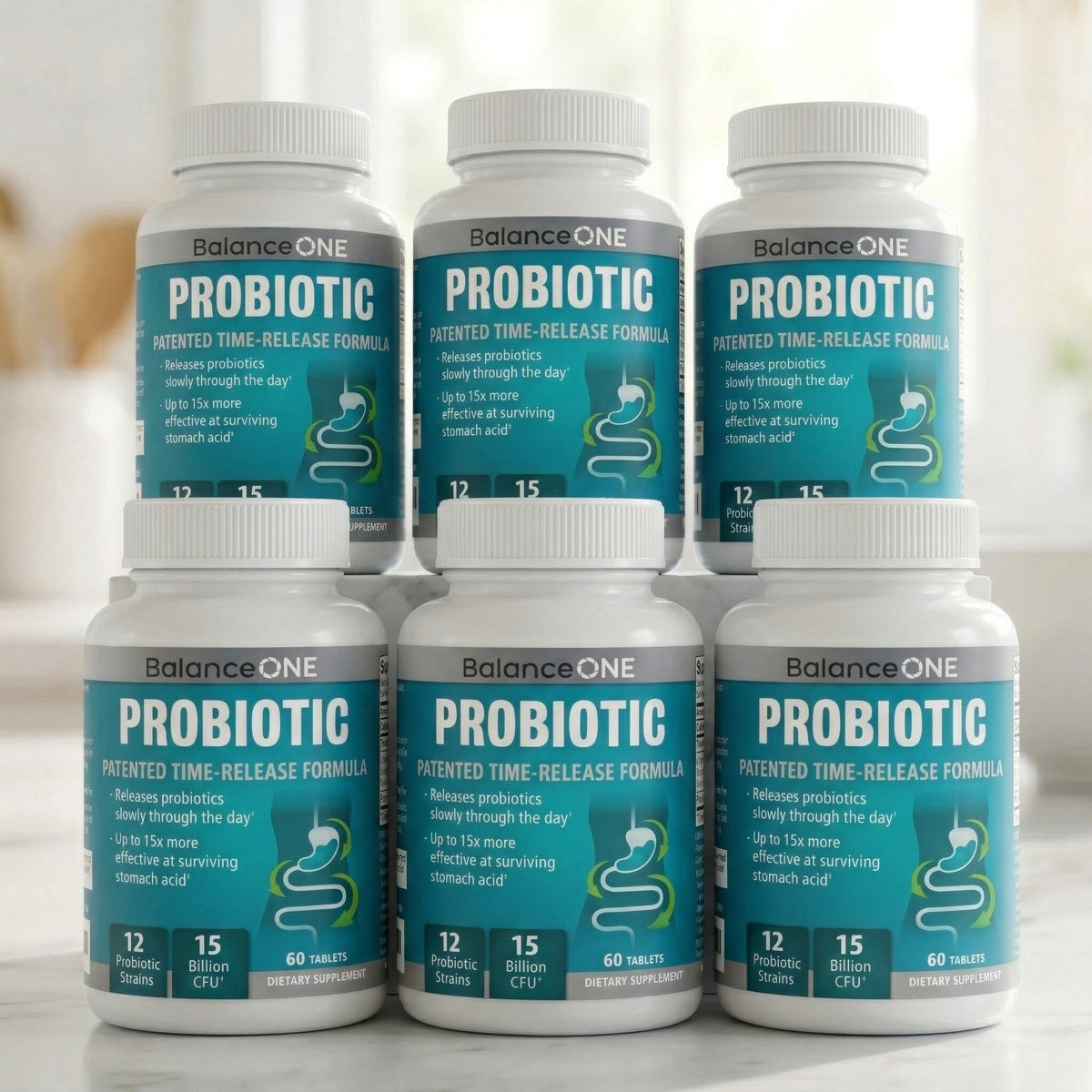
Balance ONE Probiotic does not require refrigeration. Keep the bottle tightly closed in a cool, dry place and follow the storage directions on the label. Its once-daily time-release tablet contains 12 probiotic strains and is designed for gradual release over 8–10 hours.
If you'd like to learn more about time-release technology, see Why Time-Release Probiotics Are More Effective.
Bottom Line
So, do probiotics need to be refrigerated? Not always.
Many modern probiotics are specifically formulated to remain stable at room temperature when stored according to the manufacturer's recommendations. Others require refrigeration to help maintain their quality.
The most important takeaway is to follow the storage instructions provided on the label rather than assuming every probiotic should be refrigerated. Protecting your probiotic from excessive heat, humidity, and direct sunlight can help preserve its quality regardless of whether it's stored in the refrigerator or a cupboard.
If you're just starting a probiotic, you may also find these resources helpful:
- What Is the Best Time of Day to Take Probiotics?
- 7 Signs Your Probiotic Is Working: What to Expect and When
If you are seriously ill or have a weakened immune system, check with your healthcare professional before taking a probiotic.
Frequently Asked Questions
These answers cover common questions about travel, storage temperatures, and opened bottles.
Do all probiotics need to stay in the refrigerator?
No. Many probiotics are designed to be shelf stable and can be stored at room temperature according to the manufacturer's instructions. Others require refrigeration throughout storage.
Should I refrigerate shelf-stable probiotics anyway?
In most cases, it's best to follow the storage instructions on the label. Refrigerating a shelf-stable product is usually unnecessary unless the manufacturer specifically recommends it.
Can probiotics go bad if left in a hot car?
Prolonged exposure to excessive heat may reduce probiotic viability over time. Keep probiotics out of hot cars and direct sunlight, and follow the temperature limits on the label.
How should I travel with probiotics?
Shelf-stable probiotics are generally convenient for travel because they do not normally require refrigeration. Store them in a cool, dry place and avoid leaving them in direct sunlight or inside a hot vehicle.
Can I store probiotics in my bathroom medicine cabinet?
Bathrooms often experience higher humidity and temperature fluctuations. Unless the label specifically states otherwise, storing probiotics in a cool, dry cupboard or drawer is usually a better option.
Does refrigeration make probiotics stronger?
No. Refrigeration does not increase a probiotic's potency. Appropriate storage helps preserve the live microorganisms already present. Follow the storage directions on the label.